Counter-Trafficking Action Being Taken in China
What is being done to combat human trafficking in China?
PROTECTION
Policies and procedures for victim identification
In China, only women and children can be legally recognized as trafficking victims. Victims are generally found through police raids or via information provided by members of the public or shelter staff, though there are some victims who self-report to police.Victim identification is carried out by police officers, applying Articles 240 and 241 of the Criminal Law of the People's Republic of China (1997). Police also apply domestic victim identification guidelines.
Policies and procedures for shelters
With the support of other ministries and NGOs, the Ministry of Public Security (MPS) and Ministry of Civil Affairs (MCA) provide temporary relief, return and reintegration assistance to victims of trafficking. China has a total of 1,372 administration and relief shelters and over 200 Child protection centres located in cities across the country, which provide temporary support to trafficking victims.
Shelter staff operate according to guidelines developed by the MCA which relate to receipt and care for trafficking victims and others in need, such as vagrants.
In 2009, shelters across the country have provided relief services to over 12,000 trafficked women and children, some referred by police while others were self-reported.
Post-harm assistance
Responsibility for repatriation is shared between the Chinese Police and shelter staff, sometimes with the assistance of non government partners such as Save the Children. Generally police have primary responsibility for the return of women and children victims of trafficking, but shelter staff may also play this role.
In the border provinces of southwest China, the procedure for repatriation of cross-border trafficked victims is generally: Rescue
- Victim taken to transit centre (Kunming, Yunnan or Dongxing, Guangxi Province)
- Border Liaison Office identifies victim
- Victim taken to BLO
- Victim returned to home country.
Statistics on the number of victims repatriated from China are not widely available. One media report suggests that in 2009, 272 victims were repatriated from China to Myanmar.
PROSECUTION
Specialist units for prosecution
Both local and central governments provide funding for anti-trafficking activities in China. In 2009, a large, nation- wide campaign was launched by Ministry of Public Security to combat different forms of trafficking. The campaign will continue to run throughout 2010 and has initiated a number of good practices in suppressing trafficking crimes and rescuing victims, including setting up DNA database, joint action of multi-function police, immediate response mechanism. During this period, campaigns of combating forced prostitution, illegal employment and rescue of street children and child beggars were also launched.
Resources for prosecution
Both local and central governments provide funding for anti- trafficking activities in China. In 2009, five campaigns were launched to combat different forms of trafficking, including:
- Trafficking of women and children,
- Forced prostitution,
- Illegal employment and
- Rescue of street children and child beggars.
POLICY
Significant current policies or developments which impact victims or perpetrators
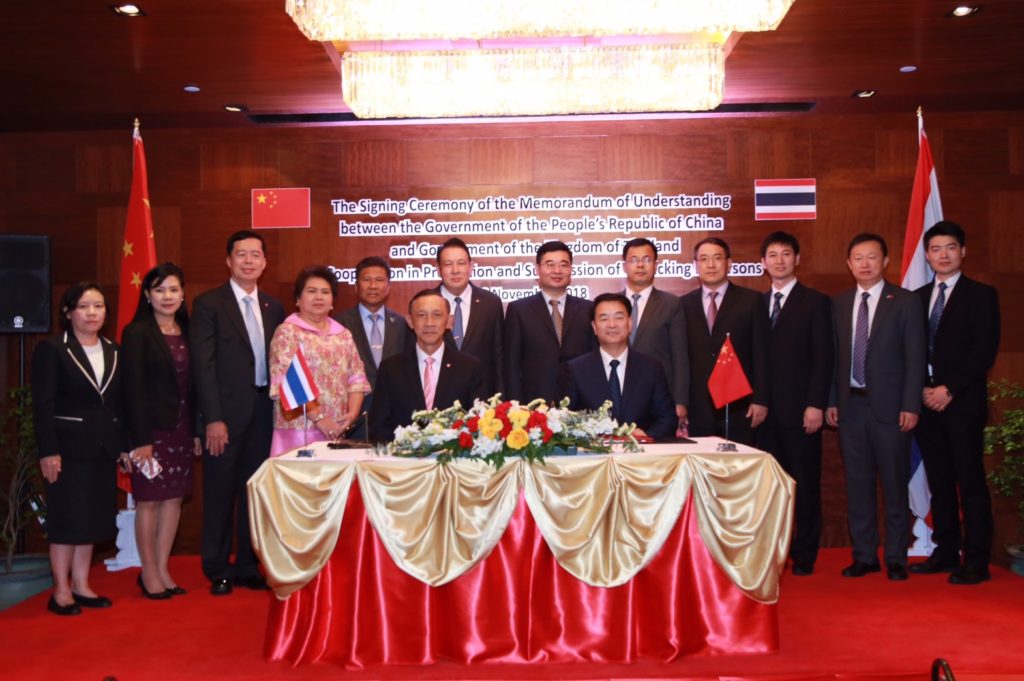
To improve cooperation between various government departments, an Inter-Ministerial Joint Meeting Mechanism (IMJMM) was established, comprising 31 members of the Communist Party and government ministries. An Anti- Trafficking Office was set up by the Ministry of Public Security to lead its anti-trafficking work and coordinate IMJMM members. Cooperative mechanisms at the provincial, municipal and county level are gradually being established.
In early 2009, the Ministry of Public Security and Central Office for the Comprehensive Management of Public Security, issued Inspection and Evaluation Standards for Anti- Trafficking Work in Women and Children.
PREVENTION
The Employment Promotion Law of the People's Republic of China (2008) aims to promote employment, promote the balance between economic development and the expansion of employment opportunities, and promote social harmony and stability.
Key awareness raising campaigns in 2009
- Growing Up Safe - campaign directed towards children. The campaign ran from May to September 2009 and was led by the All-China Women's Federation
- Care for Women, Combat Trafficking, which ran from March to June 2009, led by the Inter-Ministerial Office Against Human Trafficking
- Promotion of counter trafficking initiatives, led by the Ministry of Public Security
What Else Needs to be Done?
The articles on trafficking in the Criminal Law of the People’s Republic of China (Criminal Law of the PRC) only cover women and children, not men. Legislation should be revised so that all persons are covered in line with the definition of trafficking in the UN Trafficking Protocol.
Penalties and sentences for trafficking and related offences should be commensurate with the crime. For example, forced labour is punishable under Article 244 of the Criminal Law of the PRC with no more than 3 years imprisonment, and only if the circumstances are found to be serious. Similarly, formation or participation in criminal syndicates is punishable with a penalty of 3 to 10 years of imprisonment under Article 294 of the Criminal Law.
Improve victim identification and support systems to reach and meet the needs of victims of sex and labor trafficking, including social, psychological, medical and legal support.
Undertake rigorous, systematic research on human trafficking to get more accurate data and information.
Due to the size of the labour force and migration levels, more resources are needed from the government and donors to address trafficking and labour exploitation. These resources should be directed to improve inspection of
workplaces and training for those officials working in relevant sectors.